
Pool Bridges: Open, Closed, Rail and Mechanical Bridges Explained
Your bridge is the hand that holds the front of the cue. A solid bridge keeps the cue straight; a shaky one ruins good aim. Here are the bridges every player needs and when to use each.
Open bridge (V bridge)
Lay your hand flat on the cloth, spread your fingers, then pull your thumb up against the side of your index finger to make a V. Rest the cue in the V. Raise or lower the V by cupping your hand to aim higher or lower on the cue ball.
- Use it for: most shots, especially for beginners. It's easy to make and lets you see the whole line.
Closed bridge (loop bridge)
Start like the open bridge, then curl your index finger over the cue to make a loop, with the cue resting against your middle finger and thumb. The loop holds the cue in place.
- Use it for: power shots, the break and draw shots, where the cue might otherwise lift out of the bridge.
Rail bridge
When the cue ball is near or against a rail, put your hand on top of the rail and run the cue along the rail between your index and middle fingers, with your thumb tucked under. If the cue ball is a few inches off the rail, you can also make an open bridge on the rail top.
Elevated bridge (over a ball)
When a ball is in the way, raise your hand on your fingertips, like a tent, and rest the cue on top of your thumb and index finger. Keep the stroke short and smooth, and expect to hit down on the cue ball a little.
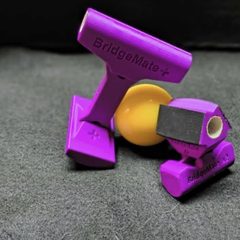
Mechanical bridge (the rake)
For shots you can't reach, use the bridge stick. Lay its head flat on the table about 6 to 10 inches behind the cue ball and hold its handle down with your bridge hand. Hold your cue with your fingertips at shoulder height and push the stroke forward like a dart. There is no shame in using it; it beats stretching off balance.
Bridge tips
- Bridge length (from bridge to cue ball) of about 6 to 8 inches works for most shots.
- Press the heel of your hand down so the bridge doesn't move.
- If your bridge hand sticks, a pool glove helps the cue slide.
Pair a good bridge with the right grip and stance: see how to hold a pool cue and pool posture. A cue-mounted bridge head is handy if your table has no rake.