
8-Ball vs 9-Ball vs 10-Ball: What's the Difference?
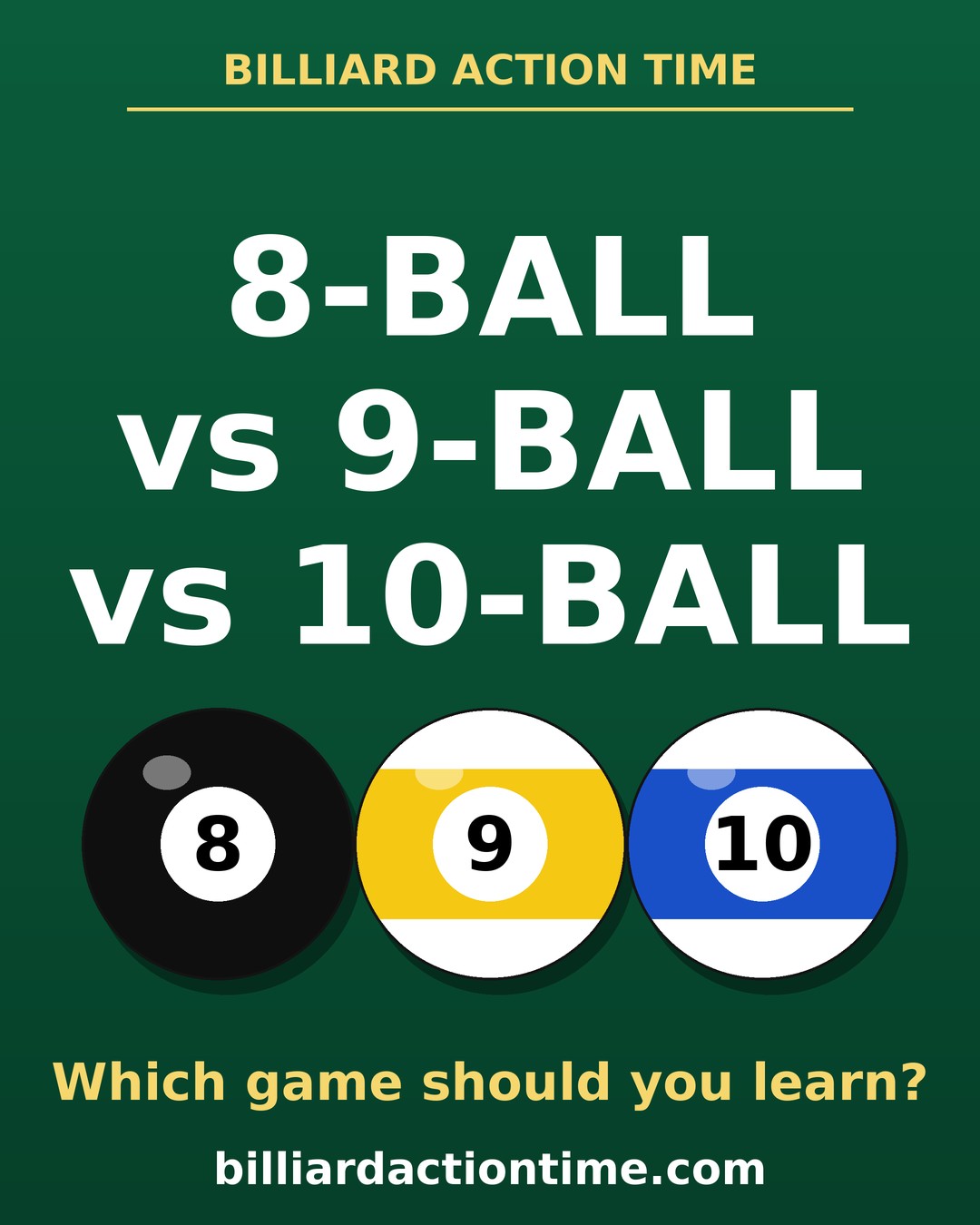
Walk into any pool hall and you will hear three names over and over: 8-ball, 9-ball and 10-ball. They all use the same table and the same cue ball, so how different can they be? Very different, as it turns out. Each game rewards a different mindset, and picking the right one can make your next session a lot more fun.
With the Mosconi Cup in Orlando coming on November 27-30, plenty of new fans are asking which game they should learn first. Here is a friendly side-by-side guide. (Rules can vary by league, bar and event, so always agree on house rules before you rack.)
8-Ball: the pool hall classic
This is the game most people learn first. All 15 numbered balls go in a triangle rack. One player takes solids (1-7), the other takes stripes (9-15), and the 8 ball is saved for last. Pocket all of your group, then pocket the black 8 ball to win.
Why people love it: it is easy to explain, it is great for beginners and it is a game of patience. You are always planning which of your balls to clear and how to block your opponent. In most bar leagues you call the pocket for the 8 ball, and sinking it early is usually a loss.
9-Ball: fast, sharp and made for TV
9-ball uses only the balls numbered 1 through 9, racked in a diamond with the 1 ball at the front and the 9 ball in the center. You must always hit the lowest-numbered ball on the table first. Pocket the 9 ball legally at any point, even on the break, and you win the rack.
That is why 9-ball is so exciting to watch: a single lucky or clever shot can end the game. After the break, the shooter often gets a "push-out," a special shot where they can move the cue ball without hitting a ball legally, then the opponent chooses whether to shoot or pass it back. It adds a mini chess match to every rack.
9-ball is the game played at the Mosconi Cup, so if you want to follow the Team USA vs Team Europe action, our 9-ball rules explainer is the perfect warm-up.
10-Ball: the precise cousin
10-ball looks like 9-ball with one more ball, and it plays that way too: you still hit the lowest-numbered ball first. The big differences are the rack, a triangle with the 10 ball in the middle, and the call-shot rule. In 10-ball you generally must name the ball and pocket you intend to use, so lucky pockets do not count as a win.
The result is a game that rewards accuracy and rewards smart safety play. Many players say 10-ball feels harder and more honest than 9-ball, which is one reason it has become a favorite in professional events around the world.
Skills each game builds
Each game trains a different part of your pool brain. 8-ball teaches you to read the whole table, spot problem balls early and play defense when you have to. 9-ball trains you to plan three or four shots ahead, since the order of the balls is fixed and your cue ball position is everything. 10-ball sharpens your shot-making under pressure because you have to commit to a called shot every time.
The nice thing is that these skills carry over. Players who practice 9-ball patterns tend to run out their 8-ball racks more smoothly, and 8-ball players who add call-shot discipline find their accuracy improves quickly. Try swapping games during practice so you never get bored.
Tips for your first session
- Agree on the rules before the break, especially whether the 8 ball must be called and what happens on a foul.
- Start with slow, smooth strokes. Power is the last thing to add.
- Learn the break last. Control and position matter far more than a big smash.
- Watch a match on TV, then copy one habit, such as the pause at the end of the backswing.
Quick comparison
- Balls used: 8-ball uses 15 plus the cue ball; 9-ball uses 9; 10-ball uses 10.
- Goal: 8-ball means clear your group then the 8; 9-ball and 10-ball mean pocket the last ball in order.
- Rack shape: triangle for 8-ball and 10-ball, diamond for 9-ball.
- Calling shots: common in 8-ball and standard in 10-ball; 9-ball usually does not require it.
- Best for beginners: 8-ball, then 9-ball.
Which one should you learn?
If you are brand new, start with 8-ball. It is forgiving, social and available at nearly every bar table. Once you are comfortable running a few balls in a row, try 9-ball to sharpen your pattern play and cue-ball control. When you want a serious precision test, give 10-ball a go.
Whatever you choose, the fundamentals stay the same: a smooth stroke, a solid stance and patient thinking. Our pool guides have tips for all three, and our tournament finder and calendar can help you find a local event to try your new favorite game.
Your turn
Which game do you play most, 8-ball, 9-ball or 10-ball? Tell us on our Facebook and Instagram pages. And if you are heading to the table this weekend, check what is happening near you.